Few weapons in military history possess a silhouette as instantly recognizable as the Thompson submachine gun. When you visit the historic battlefields of Normandy, you will see this weapon depicted in statues, encased in museum displays, and featured in the grainy archival footage of the liberation. For many American travelers, the “Tommy Gun” is not just a piece of machinery. It is a symbol of the grit and determination shown by the Greatest Generation during the crusade in Europe.
The weapon holds a unique place in American folklore. It transitioned from the lawless streets of Prohibition-era Chicago to the hedgerows of France, evolving from a gangster’s tool of choice to the trusted companion of Rangers and Paratroopers. We find that visitors to Normandy often have a deep curiosity about the specific gear carried by the soldiers who stormed Utah and Omaha Beaches. Understanding the tools they used provides a deeper appreciation for the immense physical and tactical challenges they faced.
This article explores the definitive history of the Thompson submachine gun with a specific focus on its role during the Invasion of Normandy. We will look at the technical evolution of the gun, why it was so effective in the close-quarters combat of the French bocage, and how it stacked up against German weaponry. Whether you are a history buff or planning your first pilgrimage to the landing beaches, understanding this weapon adds a layer of depth to your experience.
From Chicago Streets to the Hedgerows of France
The story of the Thompson submachine gun began long before the first boots hit the sand on D-Day. Invented by General John T. Thompson, the weapon was originally envisioned as a “trench broom” designed to break the stalemate of World War I. However, the prototype was finished just as the Great War ended, leaving the weapon without a war to fight. Instead of military trenches, the Thompson found its first fame in the hands of law enforcement and, more infamously, organized crime syndicates during the 1920s.
You likely know the image of the “Chicago Typewriter” with its distinctive drum magazine and vertical foregrip. This was the Model 1921 and Model 1928. These versions were beautifully machined, expensive, and heavy. While they captured the public imagination in gangster films, they were not yet the rugged combat implements needed for a global conflict. The US military was initially hesitant to adopt the weapon due to its high cost and the perceived lack of utility for a submachine gun in standard infantry tactics.
By the time war clouds gathered over Europe again, the need for rapid-fire personal weapons became undeniable. The Blitzkrieg tactics employed by Germany utilized the MP40 to devastating effect, proving the value of submachine guns in mobile warfare. The US Army Ordnance Department realized they needed to modernize their inventory rapidly. The Thompson was dusted off, modified for military durability, and mass-produced to arm the expanding American forces preparing to liberate Europe.
The M1A1 Variant Used on D-Day
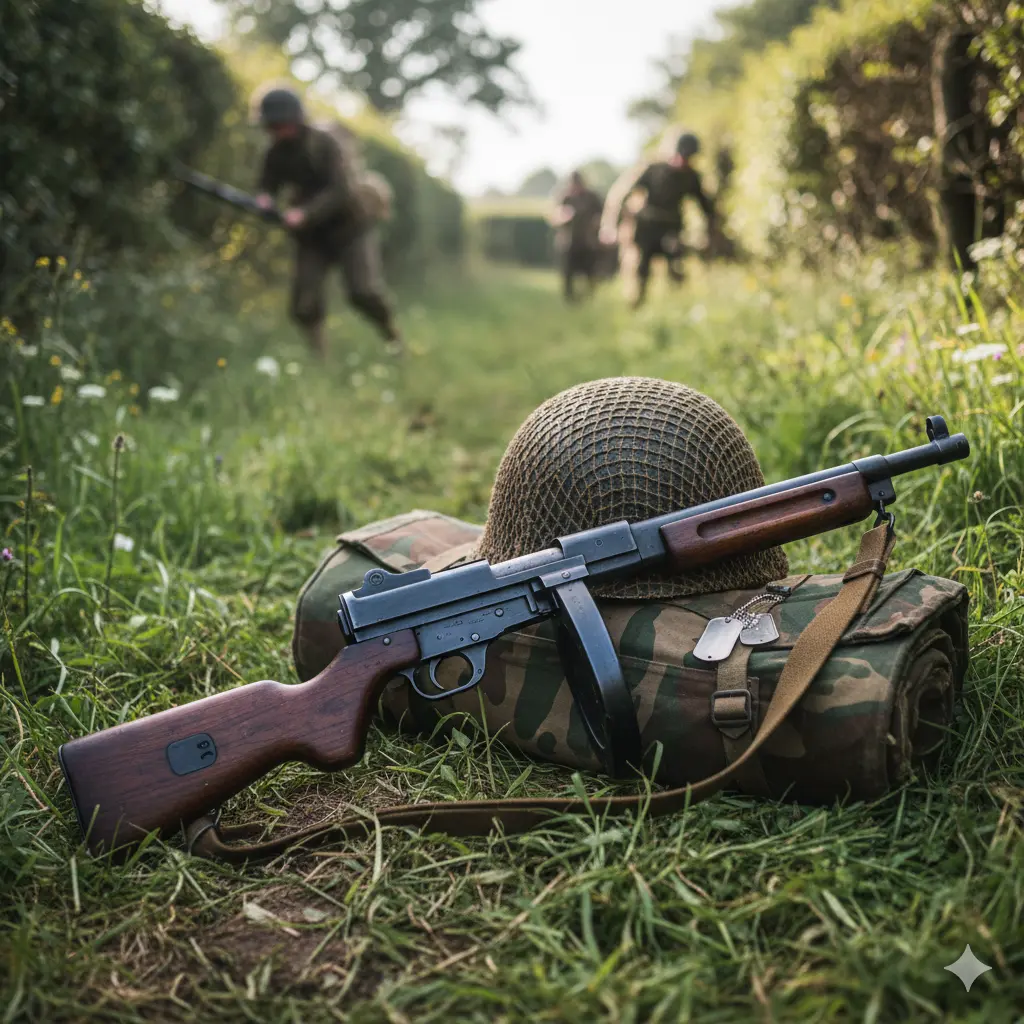
When you look at photos of soldiers on D-Day, you are rarely seeing the “gangster” version of the gun. The military simplified the design significantly to create the M1 and subsequently the M1A1 variants. This is a crucial distinction for history enthusiasts. The intricate Blish Lock mechanism was replaced with a simple blowback action, the firing rate was reduced to a manageable 600-700 rounds per minute, and the expensive drum magazines were largely replaced by 20 and 30-round box magazines.
The M1A1 was the definitive wartime model. It featured a fixed rear sight and the bolt handle was moved to the side of the receiver. These changes cut the production cost and time drastically. We want to emphasize that while the M1928 was used early in the war, the M1A1 is the gun most associated with the liberation of France. It was a robust weapon that could handle the sand of the beaches and the mud of the French countryside without jamming as frequently as more delicate machinery.
The ergonomics of the M1A1 were far from perfect, but they were familiar. It retained the hefty wooden stock and the pistol grip that soldiers appreciated. The weapon fired the heavy .45 ACP cartridge, the same ammunition used in the standard-issue M1911 pistol. This logistical synergy was vital for supply lines. When a soldier pulled the trigger of an M1A1, they were unleashing a massive amount of stopping power that was unparalleled by other submachine guns of the era.
Comparison of the Thompson and the MP40
A common topic of debate among historians and visitors to our tours is how the American Thompson compared to the German MP40. Both were iconic submachine guns of the European Theater, and they frequently clashed in the towns and fields of Normandy. While they fulfilled the same tactical role, their engineering philosophies were quite different.
The MP40 was a marvel of stamped metal and modern manufacturing, making it lighter and cheaper. The Thompson was a product of old-world milling and craftsmanship, making it heavier but incredibly durable. Below is a detailed comparison of these two rivals.
| Feature | Thompson M1A1 (USA) | MP40 (Germany) |
|---|---|---|
| Caliber | .45 ACP (11.43mm) | 9mm Parabellum |
| Weight (Loaded) | Approx. 10.6 lbs (4.8 kg) | Approx. 8.8 lbs (4.0 kg) |
| Effective Range | 50 yards (45 meters) | 110 yards (100 meters) |
| Rate of Fire | 600-700 rounds/min | 500-550 rounds/min |
| Magazine Capacity | 20 or 30-round box | 32-round box |
| Stopping Power | Very High | Moderate |
| Manufacturing | Milled steel (Labor intensive) | Stamped steel (Mass production) |
Tactical Advantage in the Bocage Country
The fighting in Normandy presented a unique tactical nightmare known as the bocage. These were sunken lanes bordered by thick, ancient hedgerows that limited visibility to mere yards. In this environment, long-range rifles like the M1 Garand or the bolt-action Springfield were often less effective because engagement distances were incredibly short. This is where the Thompson submachine gun truly shined.
You must imagine a patrol moving through a dense lane where a German ambush could be ten feet away. The ability to unleash automatic fire instantly was a lifesaver. The Thompson served as a “force multiplier” for squads clearing farmhouses and hedgerows. The .45 ACP round had enough mass to punch through light cover and wood, meaning a soldier could suppress enemy positions effectively even if they couldn’t see the exact target.
The psychological impact of the weapon was also significant. The distinct, rhythmic rattle of the Thompson was easily distinguishable from the faster “ripping canvas” sound of the German MG42 or MP40. For American GIs, hearing a Thompson firing nearby meant friendly support was close. For the enemy, the devastating impact of the heavy caliber rounds at close range was a terrifying prospect that often forced retreats during urban combat in towns like Carentan and Saint-Lô.
The Paratrooper Connection
While the Thompson was issued to NCOs and officers across the Army, it is most closely linked to the Airborne divisions. The 101st and 82nd Airborne Divisions, who dropped into Normandy in the dark hours of June 6th, prized the Thompson highly. When you visit places like Sainte-Mère-Église, you will see that the Thompson is almost synonymous with the paratrooper image.
Paratroopers needed a weapon that was compact enough to jump with but powerful enough to hold off counter-attacks until the seaborne forces arrived. The Thompson could be broken down or secured in a leg bag, though many troopers jumped with it assembled and ready. In the chaos of the scattered drops, small groups of paratroopers often found themselves isolated. The high volume of fire provided by a single Thompson gunner could allow a small band of men to outmaneuver larger German patrols.
Many famous accounts from “Band of Brothers” and other memoirs highlight the reliance on this weapon. Officers like Dick Winters utilized the Thompson effectively during assaults on fortified positions, such as the famous attack on Brécourt Manor. The weapon was heavy to carry on a long march, but in the intensity of a firefight, that weight helped absorb recoil, allowing the shooter to keep the gun on target during bursts of automatic fire.
Why Soldiers Loved and Hated the Tommy Gun
No weapon is perfect, and the Thompson had its share of critics among the troops. The primary complaint was always the weight. Carrying a fully loaded Thompson, plus extra magazines, grenades, and rations, was physically exhausting. At over 10 pounds, it was significantly heavier than the M1 Carbine, which weighed roughly half as much. For support troops or soldiers trekking long distances, the Thompson was often seen as a burden.
However, when the shooting started, the complaints usually vanished. The reliability of the M1A1 was legendary. It continued to cycle in rain, dirt, and coastal sand. The .45 caliber round offered reassurance; soldiers knew that if they hit a target, the target would go down. This stopping power inspired confidence, which is a critical factor in combat morale. While the M3 “Grease Gun” was introduced later as a cheaper, lighter replacement, many veterans refused to give up their Thompsons, preferring the solid feel of the wood-and-steel veteran.
We also find that the maintenance of the weapon was straightforward, which was essential in the field. American soldiers were trained to care for their weapons obsessively. The Thompson disassembled easily for cleaning, and its loose tolerances meant it could tolerate a fair amount of fouling before failing. This ruggedness endeared it to the men who slept in foxholes and fought in the mud for weeks on end.
Where to See a Thompson in Normandy Today
If you are planning a trip to Normandy, you have excellent opportunities to see these weapons up close. The museums in this region are among the best in the world, featuring authentic artifacts recovered from the battlefields. Viewing a Thompson submachine gun in person, noting the scratches on the stock and the wear on the metal, connects you to the history in a tangible way.
The Overlord Museum near Omaha Beach houses an incredible collection of small arms, including various models of the Thompson. Their displays often feature dioramas that show exactly how the weapon was carried and used in context. Similarly, the D-Day Experience near Carentan offers an immersive look at the paratroopers’ gear, where the Thompson features prominently alongside jump jackets and cricket clickers.
Another essential stop is the Airborne Museum in Sainte-Mère-Église. Here, you can see the weapons used by the 82nd and 101st Airborne. Seeing the gun inside a C-47 glider or next to a mannequin dressed in full jump gear helps contextualize the weight and bulk of the equipment these men carried into battle. These visits are vital for understanding the physical reality of June 1944.
Technical Specifications Summary
For those interested in the raw numbers that defined this piece of engineering, we have compiled a summary of the M1A1 specifications. Understanding these constraints helps explain the tactical decisions made by squad leaders during the invasion.
| Specification | Details |
|---|---|
| Model | Thompson M1A1 |
| Designer | John T. Thompson |
| Service History | 1938–1971 (US Military) |
| Action | Blowback, Open Bolt |
| Muzzle Velocity | 935 ft/s (285 m/s) |
| Sights | Fixed aperture rear, blade front |
| Feed System | 20 or 30-round detachable box magazine |
| Cost in 1944 | Approx. $45 (equivalent to roughly $700 today) |
Preserving the Legacy of the Trench Broom
The Thompson submachine gun is more than just a relic of warfare. It is a testament to American industrial might and the adaptability of the soldiers who wielded it. From its confused origins to its pivotal role in the liberation of Europe, the “Tommy Gun” earned its place in history. It represents the aggressive spirit required to storm a beach and liberate a continent.
When we guide visitors through the hallowed grounds of Normandy, the sight of this weapon often triggers stories passed down from grandfathers and great-uncles. It serves as a bridge between generations. We encourage you to look beyond the Hollywood movies and understand the weapon as the tool it was—heavy, reliable, and absolutely essential for the victory in 1944.
As you walk the sands of Omaha or the fields of the bocage, imagine the weight of the steel and wood in your hands. It helps ground the experience, reminding us that history was made by ordinary men carrying heavy burdens. The Thompson remains a silent witness to their courage.
Frequently Asked Questions
Did every soldier carry a Thompson submachine gun?
No, the Thompson was not standard issue for every infantryman. It was typically issued to squad leaders, officers, and specialized troops like paratroopers and Rangers. The standard infantry rifle was the M1 Garand. A typical squad might only have one or two soldiers equipped with a submachine gun.
What was the effective range of the Thompson?
The effective range was relatively short, generally around 50 yards (45 meters). While the bullet could travel much further, accuracy dropped off significantly beyond this distance due to the pistol ammunition and recoil. It was designed for close-quarters combat, not long-range engagement.
Why did the military switch from the drum magazine to the stick magazine?
The iconic drum magazines (50 or 100 rounds) were heavy, bulky, rattled when soldiers moved, and were difficult to reload under fire. They were also prone to jamming in muddy conditions. The 20 and 30-round “stick” magazines were lighter, more reliable, and fit easily into ammunition pouches.
Is the Thompson submachine gun still used today?
The Thompson was officially retired by the US military after the Vietnam War, although it saw limited use in conflicts around the world for decades. Today, it is no longer in active service with major military forces, but it remains a highly prized collector’s item and a staple of historical reenactments.