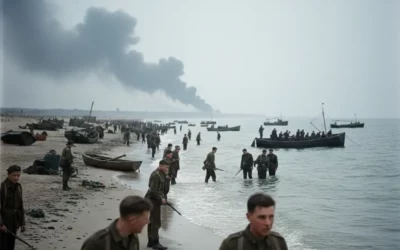
When you stand on the bluffs of Omaha Beach or look out over the quiet hedgerows of the French countryside, it is easy to imagine the roar of engines that once dominated this landscape. While the Tiger and Panther tanks often steal the spotlight in Hollywood movies and popular culture, the true backbone of the German armored forces during the Battle of Normandy was the Panzer IV. This medium tank was the workhorse of the Wehrmacht and the only German tank to remain in continuous production throughout the entire Second World War. For American travelers visiting the region, understanding this machine provides a crucial context to the fierce battles that took place here in the summer of 1944.
The Panzer IV was not just a piece of machinery. It was a formidable adversary that Allied tank crews encountered more frequently than any other German armor. By the time D-Day occurred on June 6, 1944, this tank had evolved significantly from its early days as an infantry support vehicle into a dedicated tank hunter capable of knocking out American Shermans and British Cromwells. Its history is deeply intertwined with the geography of Normandy. From the streets of Caen to the Falaise Pocket, the rusted tracks of the Panzer IV are part of the soil here. We believe that to truly appreciate the scale of the Allied victory, you must respect the capability of the opposition they faced.
In the weeks following the invasion, American GIs and British Tommies quickly learned to respect the high-velocity gun of the Panzer IV. It was versatile, reliable, and available in numbers that the heavier Tiger tanks could never achieve. As we guide you through the technical specifications and historical impact of this legendary vehicle, you will gain a deeper appreciation for the bravery required to face them in combat. Whether you are a dedicated history buff or a casual traveler looking to understand the significance of local museums, this deep dive into the Panzer IV will enhance your upcoming journey to Normandy.
The Evolution of a Battlefield Legend
The development history of the Panzer IV is a testament to German engineering adaptability under pressure. Originally designed in the late 1930s, it was intended to serve as a support tank, firing high-explosive shells to take out bunkers and infantry positions while the lighter Panzer III handled enemy tanks. However, the realities of war forced a dramatic shift in this doctrine. When Germany invaded the Soviet Union, they encountered the T-34, a tank that completely outclassed their existing armor. This shock forced German engineers to up-gun and up-armor the Panzer IV, transforming it into their primary main battle tank by the time the Atlantic Wall came under attack.
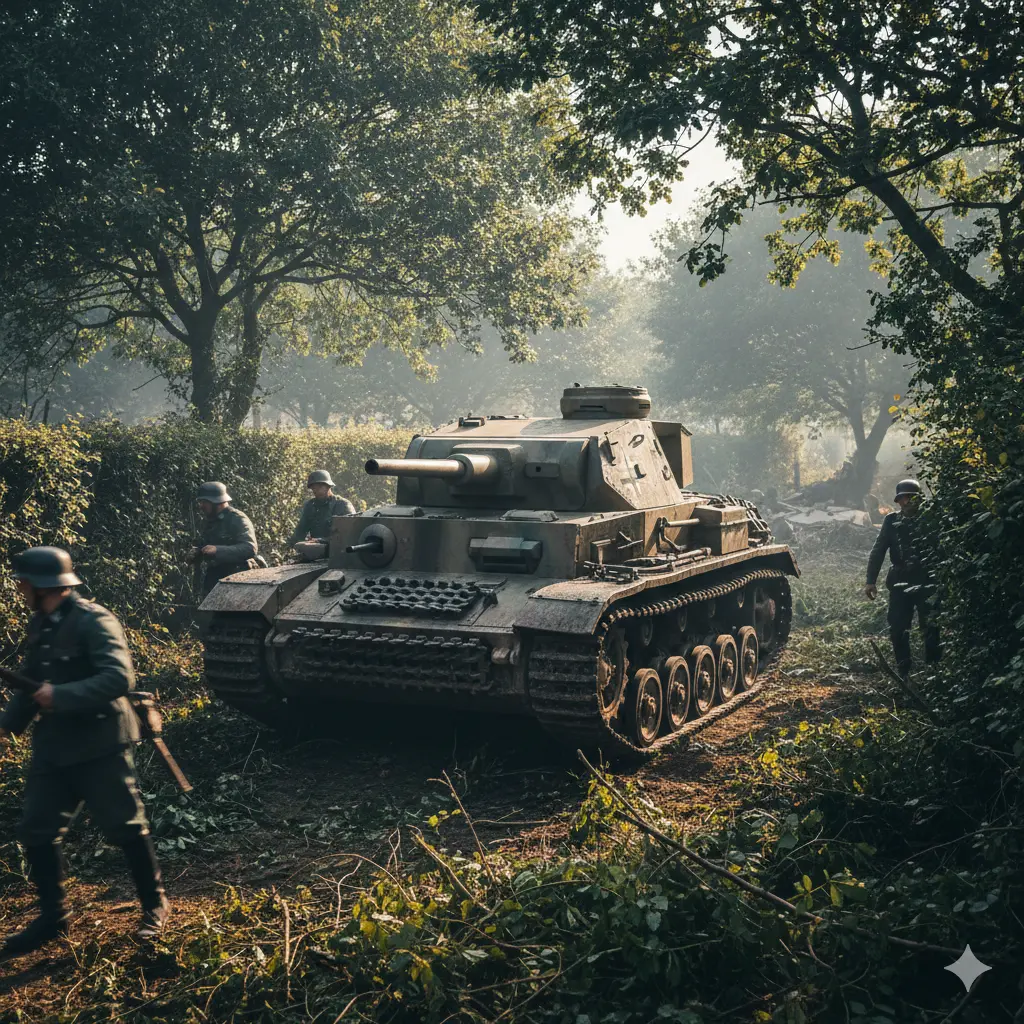
By 1944, the versions of the Panzer IV waiting for Allied troops in Normandy were primarily the Ausführung H (Ausf. H) and the Ausführung J (Ausf. J). These models were significantly different from their predecessors. They featured thicker frontal armor, reaching 80mm, which made them difficult to penetrate with standard Allied guns from long ranges. They also featured distinct “Schürzen” or side skirts. These were thin steel plates hung on the sides of the hull and turret to pre-detonate anti-tank weapon charges and protect the tracks from Soviet anti-tank rifles. In the narrow lanes of the Bocage, these skirts gave the tank a menacing, boxy silhouette that American soldiers learned to identify instantly.
Production numbers tell the real story of its importance. While the fearsome Tiger I saw a production run of only about 1,300 units, over 8,500 Panzer IVs were built. In the Normandy campaign, they made up roughly half of the available German tank strength. This means that if an American Sherman crew reported engaging a “Tiger,” they were statistically much more likely to be fighting a Panzer IV. The confusion was common because, in the heat of battle, the upgraded gun and armor of the Panzer IV made it a lethal threat that demanded immediate attention. Understanding this evolution helps you realize that the German defense of Normandy relied not on “wonder weapons” but on this reliable, mass-produced chassis.
Firepower and Mobility in the Bocage
The defining feature of the Panzer IV in Normandy was its main armament. The tank was equipped with the 7.5 cm KwK 40 L/48 gun. This long-barreled cannon was a game-changer. It gave German crews the ability to penetrate the frontal armor of an M4 Sherman from over 1,000 meters away. For American crews, this was a terrifying reality. Standard Shermans often had to close the distance to under 500 meters to effectively knock out a Panzer IV from the front. This range disparity dictated many of the tactical engagements across the French countryside, forcing Allied commanders to use air support and artillery to neutralize German armor superiority.
Mobility was another critical factor, specifically regarding the terrain of Normandy. The region is famous for its “Bocage” country. These are sunken roads lined with thick, centuries-old hedgerows that act as natural fortifications. The Panzer IV was reasonably mobile, with a top speed of around 24 mph (38 km/h) on roads, powered by a Maybach HL 120 TRM engine. While not as fast as the American Hellcat tank destroyers, it was agile enough to maneuver within the defensive lines. German tactics involved hiding these tanks behind the hedgerows, creating deadly ambushes. The low profile of the Panzer IV compared to the tall Sherman made it easier to conceal, turning every field into a potential kill zone.
However, the tank was not without its flaws. By 1944, the chassis was overloaded. The additional armor and the heavy gun put immense strain on the suspension and transmission. In the retreat across France, many Panzer IVs were abandoned not because of combat damage, but because they ran out of fuel or suffered mechanical breakdowns that could not be repaired in the field. The German logistical nightmare in Normandy, exacerbated by Allied air superiority, meant that a Panzer IV was often a stationary pillbox rather than a mobile weapon. When you visit the battlefields today, look at the narrow roads and imagine a 25-ton steel beast trying to navigate them while under constant threat from Typhoon and Thunderbolt fighter-bombers.
Comparison of Key Tank Statistics
| Feature | Panzer IV (Ausf. H) | M4 Sherman (75mm) |
|---|---|---|
| Main Armament | 7.5 cm KwK 40 L/48 | 75mm M3 L/40 |
| Effective Range | Approx. 1,000+ meters | Approx. 500 meters |
| Frontal Armor | 80mm | 51mm (sloped) |
| Combat Weight | 25 tons | 30 tons |
| Top Speed | 24 mph (38 km/h) | 25-30 mph (40-48 km/h) |
| Crew | 5 (Commander, Gunner, Loader, Driver, Radio) | 5 |
| Production Total | ~8,500 | ~49,000 |
Tactical Matchups Against Allied Armor
The combat dynamic between the Panzer IV and Allied armor is a subject of intense study for military historians. On paper, the matchup seemed to favor the Germans regarding individual vehicle performance. The high-velocity 75mm gun of the Panzer IV could slice through the Sherman, Cromwell, and Churchill tanks. However, war is not fought on paper. The Allies had two distinct advantages that the Panzer IV could not overcome: numbers and logistics. For every Panzer IV destroyed, the Allies could deploy multiple Shermans to take its place. This attrition warfare was brutal for the crews involved, but it was a winning strategy for the liberation of Europe.
American tank crews developed specific tactics to deal with the Panzer IV. They learned to flank the German tanks, hitting them in the thinner side and rear armor. The use of White Phosphorus shells was another tactic used to blind German optics or force the crew to evacuate due to smoke. Furthermore, the British introduced the Sherman Firefly, a variant equipped with a massive 17-pounder gun capable of destroying any German tank, including the Panzer IV, from long range. These tactical innovations leveled the playing field and prevented the German Panzer divisions from driving the Allies back into the sea.
One cannot discuss these matchups without mentioning the role of the crew. By 1944, many German tank crews were experienced veterans who had fought on the Eastern Front. They knew how to maximize the strengths of the Panzer IV. Conversely, many Allied crews were entering combat for the first time. Yet, the loss of German training schools and the fuel shortage meant that replacement crews for the Wehrmacht were increasingly green as the campaign dragged on. By the closing of the Falaise Pocket in August 1944, the tactical proficiency gap had closed, and the sheer weight of Allied firepower overwhelmed the remaining Panzer IV formations.
Notable Units and Engagements in Normandy
Several German Panzer divisions equipped with the Panzer IV played pivotal roles in the Battle of Normandy. The 21st Panzer Division was the closest armored unit to the beaches on D-Day. They launched a counterattack between Juno and Sword beaches that nearly reached the coast. Their Panzer IVs were instrumental in this thrust, which was the only major German armored response on June 6. Had they been supported by more infantry and not hesitated due to confusing orders, the history of D-Day might have looked quite different. This “what if” scenario highlights the lethality of the Panzer IV when positioned correctly.
Another fearsome unit was the Panzer Lehr Division. This was an elite unit, better equipped than almost any other German division. They fought fiercely around the city of Caen and later in the hedgerows against American forces near Saint-Lô. Their Panzer IVs were heavily involved in the battles for Hill 112 and the defense against Operation Cobra. The 12th SS Panzer Division “Hitlerjugend” also relied heavily on the Panzer IV. These units fought with fanaticism, and their tanks were often used in aggressive counterattacks that caught British and Canadian forces off guard. The wreckage of their vehicles littered the corridor of death near Falaise.
We encourage you to visit the memorial sites around Caen and the Falaise Pocket. The intensity of the fighting there resulted in the destruction of hundreds of Panzer IVs. Seeing the terrain helps explain why the battles were so grindy and slow. The tank was perfectly suited for holding the line in this environment. It could utilize long sightlines across open fields and then retreat behind farm buildings or woods. The presence of these units turned the Battle of Normandy into a battle of attrition that tested the resolve of every soldier involved.
Where to See a Panzer IV in Normandy Today
For those of you planning a trip, seeing a Panzer IV in person is a powerful experience. It allows you to visualize the scale and engineering of the enemy equipment. Fortunately, Normandy and its surrounding regions preserve this history well. One of the best places to view a Panzer IV is the Overlord Museum located near Omaha Beach, just down the road from the American Cemetery in Colleville-sur-Mer. Their collection includes a beautifully restored Panzer IV, displayed in a diorama that mimics the conditions of the Normandy campaign. It is an excellent stop immediately after paying your respects at the cemetery.
Another essential stop is the Memorial Museum of the Battle of Normandy in Bayeux. This museum provides a comprehensive overview of the operations following D-Day and features a wide array of heavy equipment. Further inland, the museum dedicated to the closing of the Falaise Pocket (Mémorial de Montormel) offers incredible views of the battlefield where the German army was finally encircled. While they may not always have a Panzer IV on external display, the context provided there regarding the destruction of the Panzer divisions is unmatched.
If you are willing to travel slightly outside of Normandy, the Musée des Blindés in Saumur remains the holy grail for tank enthusiasts in France. It houses one of the largest collections of operational tanks in the world, including multiple variants of the Panzer IV. However, if your itinerary is strictly limited to the landing beaches and immediate battlefields, the Overlord Museum is your most convenient and high-quality option. Seeing the tank up close, you will notice the rough welding, the Zimmerit anti-magnetic paste texture on the armor, and the cramped conditions the crews endured.
Summary of the Panzer IV’s Legacy
| Aspect | Details |
|---|---|
| Strategic Role | The main battle tank of the Wehrmacht; held the line against Allied advances. |
| Main Advantage | Powerful 75mm gun capable of defeating Allied armor at range. |
| Main Weakness | Thin side armor and mechanical strain from added weight. |
| Survivability | Low against Allied air power and flanking maneuvers. |
| Historical Impact | Inflicted heavy casualties on Allied armor but could not stop the invasion. |
Reflecting on the Machinery of War
The story of the Panzer IV is not just about steel specifications and caliber sizes. It is a story about the terrifying reality of armored warfare in 1944. This tank represents the formidable obstacle that the “Greatest Generation” had to overcome to liberate Europe. It was a weapon of immense destruction, engineered by a regime that had conquered the continent, yet it was ultimately defeated by the courage, resources, and determination of the Allied forces. When you see one of these tanks in a museum, do not just see a relic. See the challenge it posed.
We hope this guide has provided you with the knowledge to identify and understand the Panzer IV during your travels. Recognizing the difference between a Panzer IV and a Tiger, or understanding why the Sherman crews feared that long-barreled gun, adds a layer of depth to your visit. It transforms a static display into a vivid historical narrative. As you walk the beaches and the bocage lanes, you now carry a piece of that history with you.
Normandy is a place of memory, and knowing the details of the conflict ensures that the memory remains accurate and respectful. We invite you to explore the museums, stand on the battlefields, and reflect on the immense cost of freedom. The rusted tracks of the Panzer IV serve as a silent witness to a summer that changed the world forever.
Frequently Asked Questions
Was the Panzer IV better than the Tiger tank?
Not in terms of raw armor or firepower. The Tiger was heavier and had a more powerful gun. However, the Panzer IV was more reliable, cheaper to produce, and easier to transport. It was “better” in the strategic sense that it could be fielded in numbers that actually impacted the battlefield, whereas the Tiger was rare and mechanically fragile.
How many Panzer IVs were in Normandy?
Estimates vary, but historians suggest that several hundred Panzer IVs were present in Normandy with the various Panzer divisions (such as the 21st, 2nd, 116th, and SS divisions). They constituted the majority of the German tank force in the region, outnumbering Panthers and Tigers combined.
Could a Sherman tank destroy a Panzer IV?
Yes. While the Panzer IV had superior range, a standard 75mm Sherman could destroy a Panzer IV from the side or rear, and from the front at close range (under 500 yards). The 76mm-armed Shermans and British Fireflies could destroy the Panzer IV from long distances.
What is Zimmerit and did Panzer IVs have it?
Zimmerit was a paste applied to German tanks to prevent magnetic anti-tank mines from sticking to the hull. Most Panzer IVs in Normandy were coated with this distinct, rough-textured paste. You can often see this texture on models preserved in museums today.
Why did the Panzer IV have side skirts?
The side skirts, or Schürzen, were originally designed to protect against Soviet anti-tank rifles on the Eastern Front. In Normandy, they proved useful against Allied HEAT (High-Explosive Anti-Tank) rounds from bazookas and PIAT launchers, though they frequently fell off during movement through the thick hedgerows.